A Practical Guide for Importers and Buyers
If you have ever received a message like this from your client:
“The coffee is leaking from the bottom.”
“Customers are complaining.”
“We need compensation.”
Then you already know.
A leaking paper cup is not a small problem.
It becomes a logistics problem.
A customer service problem.
A reputation problem.
And sometimes, a legal problem.
How a Paper Cup Is Supposed to Hold Liquid
Before talking about failure, we need to understand the structure.
A standard paper cup has four key layers:
- Food-grade paperboard
- Inner coating (PE, PLA, or water-based)
- Side seam sealing
- Bottom disc sealing
If any one of these fails, the cup leaks.
Not “maybe.”
It will leak.
This structure looks simple.
But in mass production, controlling it is not easy.
Root Cause 1: Poor Inner Coating Quality
The inner coating is the first defense against liquid.
Most factories use:
- PE coating (polyethylene)
- PLA coating (bioplastic)
- Water-based barrier coating
If this layer is unstable, leaks start here.
Common coating problems
- Uneven thickness
- Thin coating at fold lines
- Weak melt strength
- Poor adhesion to paper
These create microscopic cracks.
You cannot see them with eyes.
But hot coffee finds them.
Low-quality coating saves cost.
But it multiplies risk.
Root Cause 2: Weak Side Seam Sealing
The side seam is where the paper sheet becomes a cylinder.
It is the most sensitive area.
If this joint fails, the cup leaks sideways.
Why side seams fail
In factories, sealing depends on:
- Hot air temperature
- Sealing wheel pressure
- Line speed
- Operator skill
If speed is too fast.
If temperature is too low.
If rollers are dirty.
The seam looks closed.
But it is not fully fused.
This is why two cups from the same order can behave differently.
Process control matters.
Root Cause 3: Bottom Sealing Failure
Most buyers notice leaks at the bottom.
This is not random.
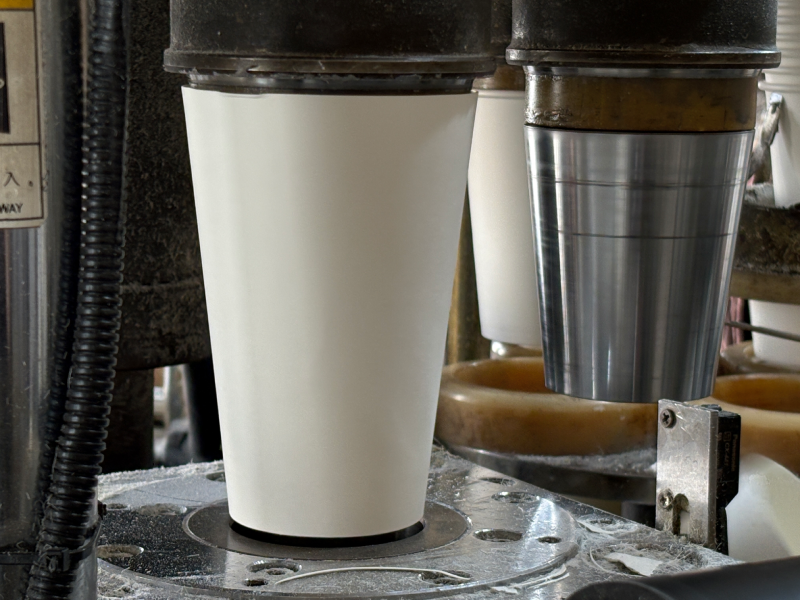
The bottom disc is sealed by curling and heating.
Three things must match:
- Heat
- Pressure
- Timing
If any is off, sealing is incomplete.
Typical bottom problems
- Cold seal
- Misaligned bottom disc
- Incomplete curling
- Paper rebound
The cup may pass visual inspection.
But after 10 minutes with hot liquid, it fails.
This is why proper testing matters.
Root Cause 4: Wrong Paperboard Selection
Not all paper is equal.
Some suppliers cut cost here.
That is dangerous.
Paperboard factors
- GSM (gram per square meter)
- Wet strength additives
- Fiber composition
- Surface sizing
Low GSM paper softens quickly.
High recycled content absorbs more water.
Weak wet strength = fast collapse.
Root Cause 5: Hot Cup Used for Cold Cup Applications
This happens more than buyers realize.
Some importers order “one cup for everything.”
That does not work.
Cold drink cups
- Thin coating
- Lower GSM
- No heat resistance
Hot drink cups
- Thicker coating
- Higher stiffness
- Heat-resistant bonding
Using cold cups for coffee leads to:
- Soft walls
- Seam opening
- Bottom failure
It is predictable.
How Professional Factories Test for Leakage
Serious factories do not rely on appearance.
They test.
Every day.
Standard leak tests
- Water soak test (24 hours)
- Hot liquid test (90°C+)
- Seam peel strength test
- Random sampling
- Aging test
How We Control Leakage Risk in Our Factory
We focus on systems.
Not promises.
Our main controls
- Qualified coating suppliers
- Fixed sealing parameters
- Daily machine calibration
- Operator training
- Batch traceability
- Incoming paper inspection
Every batch is recorded.
If a problem appears, we can trace it.
Common Buyer Mistakes
After many years, I see patterns.
Frequent mistakes
- Choosing lowest price only
- Skipping hot liquid testing
- No pre-shipment inspection
- Rushing production
- Changing specs mid-order
These create future disputes.
Not savings.
Transportation and Storage Risks
Even perfect cups can fail after shipping.
Risk factors
- Container humidity
- Condensation
- Heavy stacking
- Long storage
Moisture weakens paper.
Crushed cartons deform cups.
Always control logistics conditions.
When Leaks Happen: How to Investigate
If leakage appears, do not argue emotionally.
Investigate systematically.
Step-by-step
- Isolate defective samples
- Locate leak point
- Check batch number
- Review production record
- Review storage condition
This protects both buyer and supplier.
Final Thoughts: Leaking Cups Are Preventable
Paper cups do not leak by nature.
They leak when systems fail.
- Material control fails
- Process control fails
- Quality control fails
- Communication fails
Good suppliers manage systems.
Smart buyers manage specifications.
When both sides cooperate, leakage disappears.
That is the reality of professional manufacturing.